

Thursday, November 12, 2009


Or... We could just build a mountain!
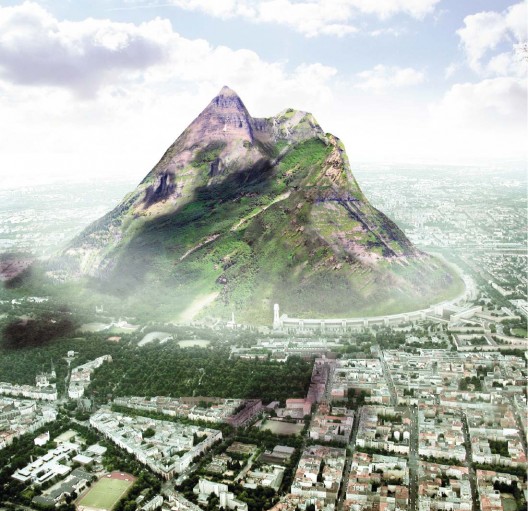

German architect Jakob Tigges has projected a new and visionary landmark in Berlin. He plans to build a mountain of 1,000 meters high called “The Berg”, which would become a never-before-seen tourist destination in the German capital city
oh Thom...

Of course you can be in our comic, you say some great things:
"The huge problem in our society is the enormous ignorance of the ideas that underlie modern art. Whether you look at Picasso, the surrealists or Duchamp, somewhere along the line you’re going to encounter Marx, Freud or Einstein. In a certain sense they redefined our image of ourselves, because when we ask the question who we are as human beings, the answer always refers back to ideas. They form our brains and in doing so they form the world... We only exist in terms of how we think we exist. Meaning every cultural development is fabricated and can be fabricated. So at a time in which the media give the public everything it wants and desires, maybe art should adopt a much more aggressive attitude towards the public. I myself am very much inclined to take this position."
"Architecture is involved with the world, but at the same time it has a certain autonomy. This autonomy cannot be explained in terms of traditional logic because the most interesting parts of the work are non-verbal. They operate within the terms of the work, like any art."
‘The idea of the future is dead! Now we know that the world changes in totally unpredictable ways and that a single human act can make the future look entirely different. So it’s pointless to come up with ideas about the future. As an architect, do I need a vision of the world? Of course! But that vision doesn’t extend any further than tomorrow. Ask me if I’m optimistic and hopeful. I’ll say, Yes, definitely. It’s in my nature.’
‘Descriptions of my work depress me. They make me feel pinned down. For me the meaning of my work is much more fluid. My buildings don’t speak in words but by means of their own spaciousness. You might say that when you step inside, you’re entering a honorific space, but that’s something totally different than experiencing it. And in architecture the experience comes first. That has the deepest effect on us.
“Do I provoke as a method of investigation? Of course. That’s the essence of architecture. Do I do it with gusto? I do."
“I fought violently for the autonomy of architecture. It’s a very passive, weak profession where people deliver a service. You want a blue door, you get a blue door. You want it to look neo-Spanish, you get neo-Spanish.
“Architecture with any authenticity represents resistance. Resistance is a good thing.”
A LITTLE POST SCRIPT ON RESISTANCE:
http://lebbeuswoods.wordpress.com/2009/05/09/architecture-and-resistance/
Wednesday, November 11, 2009


body+landscape

People understand landscape as a scenic picture. For me the deeper meaning is about how your body uses landscape. So walking, cycling, gardening, all the ways you use the land, are more fundamental than just its appearance.- james corner
here's that concrete you ordered


well, not quite concrete, but 51000 ceramic tiles.
there are more photos plus a diagram video at archdaily

Grassplosion
Just to get this out of my system...


Ahhhh... sweet relief. Now let's pour some concrete.
Modern, Romantic? Construction vs. Seduction?
I don't really know, but I think he has a point somewhere.
Esmeralda

In Esmeralda, city of water, a network of canals and a network of streets span and intersect each other. To go from one place to another you have always the choice between land and boat: and since the shortest distance between two points in Esmeralda is not a straight line but a zigzag that ramifies in tortuous optional routes, the ways that open to each passerby are never two, but many, and they increase further for those who alternate a stretch by boat with one on dry land.
And so Esmeralda’s inhabitants are spared the boredom of following the same streets every day. And that is not all: the network of routes is not arranged on one level, but follows instead an up-and-down course of steps, landings, cambered bridges, hanging streets. Combining segments of the various routes, elevated or on ground level, each inhabitant can enjoy every day the pleasure of a new itinerary to reach the same places. The most fixed and calm lives in Esmeralda are spent without any repetition.
Secret and adventurous lives, here as elsewhere, are subject to greater restrictions. Esmeralda’s cats, thieves, illicit lovers move along higher, discontinuous ways, dropping from a rooftop to a balcony, following gutterings with acrobats’ steps. Below, the rats run in the darkness of the sewers, one behind the other’s tail, along with conspirators and smugglers: they peep out of manholes and drainpipes, they slip through double bottoms and ditches, from one hiding place to another they drag crusts of cheese, contraband goods, kegs of gunpowder, crossing the city’s compactness pierced by the spokes of underground passages.
A map of Esmeralda should include, marked in different colored inks, all these routes, solid and liquid, evident and hidden. It is more difficult to fix on the map the routes of the swallows, who cut the air over the roofs, dropping long invisible parabolas with their still wings, darting to gulp a mosquito, spiraling upward, grazing a pinnacle, dominating from every point of their airy paths all the points of the city.
Thom Mayne has words
A video, and an article. For us:
"His design philosophy opposes the “conservative” idea of “architecture as a contextual activity,” wherein buildings are simply efficient containers for the prearranged activities that take place inside them. Mayne prefers constructing large-scale “environments” wherein the architecture provokes an active dialogue: the buildings and its surroundings mutually interpret each other. Innovation arises in a matrix of conflicts — rather than necessarily underwriting the given function of a space, Mayne’s designs often challenge the idea of spatial coherence."
Active dialog, yes. Coherence challenge, maybe. Constructing environments, certainly.
Tuesday, November 10, 2009
cuteoverload: Home Addition

here's the mini-cabin thingy that got me thinking like ol' Bucky. Can you just imagine a bunch of these guys snuggling up?
Sunday, November 8, 2009
le jardin, la maison

Oldie but goodie but true-ie
-Claude Monet
Wednesday, November 4, 2009
another reason (besides bird bridge) to love visiondivision

i just wasted half an hour destroying evil architecture!

words of wisdom
There's a saying that goes "People who live in glass houses shouldn't throw stones." Okay. How about "Nobody should throw stones." That's crappy behavior. My policy is: "No stone throwing regardless of housing situation." Don't do it. There is one exception though. If you're trapped in a glass house, and you have a stone, then throw it. What are you, an idiot? So maybe it's "Only people in glass houses should throw stones, provided they are trapped in the house with a stone." It's a little longer, but yeah.
-Demetri Martin
glass


Acclaimed architect Bruno Taut said, “If we want our culture to rise to a higher level, we are obligated for better or for worse, to change our architecture. And this only becomes possible if we take away the closed character from the rooms in which we live. We can only do that by introducing glass architecture, which lets in the light of the sun, the moon, and the stars”.


FUKSAS


The New Milan Trade Fair
500,000 sq foot canopy+ moving sidewalks+ marble walkways + 20,000 parking stalls + magical paint that offsets pollution caused by cars + 2000 trees + inside + outside + glass + steel - tradition and common sense = this


Subscribe to:
Posts (Atom)